
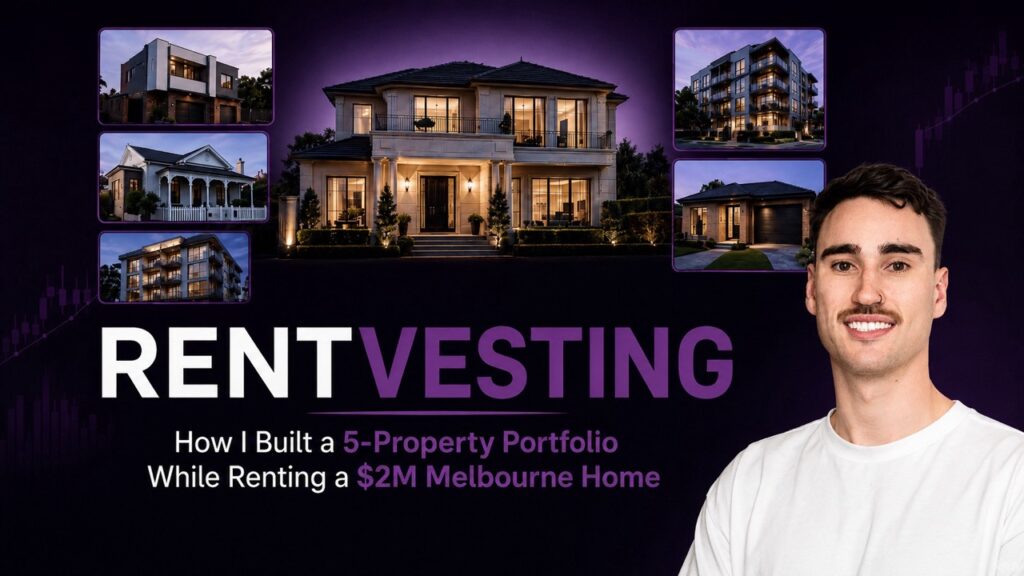
Most people in their 20s are doing one of two things with property: saving desperately to buy their first home, or deciding it’s all too hard and doing nothing. I chose a third path — and it’s called rentvesting.
Right now, I’m renting a $2,000,000 home in Melbourne with two mates, splitting the cost three ways. I don’t own the roof over my head. What I do own is five investment properties spread across Queensland and Western Australia — and here’s what that portfolio looks like today:
| Property | Purchase Price | Current Value | Growth |
|---|---|---|---|
| #1 — Perth, WA | $410,000 | $900,000+ | +$490,000 |
| #2 | $367,500 | $650,000 | +$282,500 |
| #3 | $500,000 | $650,000 | +$150,000 |
| #4 & #5 | $520,000 | $650,000 | +$130,000 |
That’s over $1,050,000 in combined capital growth — across properties I’ve never lived in, in markets I don’t live near.
If I’d bought in Melbourne instead, I’d have a single mortgage on a property in a market that’s delivered a fraction of that growth. I’d also be house-poor, with most of my income locked into a home loan I’d be paying off for the next 30 years.
Rentvesting let me do something different: live where I want, invest where the numbers make sense, and build real wealth while I’m still young enough to do something with it.
What is rentvesting?
Rentvesting is a property strategy where you rent the home you live in — typically in a location you love or can’t afford to buy in — while simultaneously owning investment properties in other markets.
Instead of following the traditional path of “save, buy your home, then maybe invest one day,” rentvestors flip the script. They use their savings and borrowing capacity to buy in high-growth or high-yield markets anywhere in the country, while renting a lifestyle they enjoy at a cost that doesn’t strangle their cash flow.
It’s not a new concept, but it’s still far from mainstream. Most people haven’t heard of it, and those who have often dismiss it with the same tired line: “You’re just throwing money away on rent.”
That idea is worth pulling apart — because it’s one of the most expensive financial myths in Australia.
“You’re throwing money away on rent” — let’s kill this myth
Here’s the logic people use: rent payments go to someone else, so you’re “wasting” money with nothing to show for it.
By that logic, paying interest on a mortgage is also throwing money away — and for the first decade or so of a 30-year loan, the vast majority of your repayments are interest, not principal. You’re paying the bank, not building equity.
The real question isn’t “am I renting or owning?” The real question is: what is my money doing?
When I bought my Perth property for $410,000, I was still living at home, which meant my cost of living was low and my borrowing capacity was strong. I now rent with two mates, splitting the cost of a $2M home three ways — which means my actual rental contribution is a fraction of what a mortgage on a comparable property would cost me. That difference, every single month, is capital I can deploy into the next investment.
Meanwhile, my Perth property has nearly doubled in value. The “rent is dead money” crowd would have had me buy a median-priced Melbourne home instead. The numbers don’t lie.
Why I stopped looking in my own backyard
When I first started looking at property, Melbourne was where I lived, where I worked as a plumber, and where it felt natural to invest. It’s what everyone around me expected.
But when I actually sat down and looked at the data, Melbourne wasn’t the right market at the time. Growth was slow, yields were thin, and entry prices were high. I was paying a premium for familiarity.
Australia has over 15,000 suburbs. Limiting myself to the ones I could drive to was never a strategy — it was just comfort.
So I expanded my search. Perth and Queensland were the markets that made sense. The fundamentals were strong, prices were still accessible, and the growth potential was backed by population trends, infrastructure investment, and rental demand. My first purchase in Perth at $410,000 has since grown to over $900,000. That’s not luck — that’s what happens when you buy in the right market at the right time, regardless of where you live.
How rentvesting actually works — the mechanics
If you’re considering rentvesting, here’s a plain-English breakdown of how it works in practice.
You rent where you live. You choose a rental that suits your lifestyle, whether that’s close to work, near mates, or in a suburb you love. You’re not locked in — you can move when you want. Your rental costs are generally lower than a mortgage would be on a comparable property, especially when you split with housemates.
You buy where the data points. Your investment property doesn’t need to be somewhere you’d ever live. It needs to be somewhere with strong fundamentals: population growth, infrastructure spend, rental demand, and accessible entry prices. For many Australians in their 20s and 30s right now, that means looking at Queensland and Western Australia rather than Sydney or Melbourne.
Your borrowing capacity works in your favour. This is something most people miss. Because your rent is shared (or relatively low), your monthly expenses are lower than they would be if you’d bought a home. Lenders assess your borrowing capacity based on your income versus your liabilities — keeping your personal living costs down means you can borrow more, and do it again sooner.
You build a portfolio, not just a property. The goal of rentvesting isn’t to own one property. It’s to build a portfolio across multiple markets that generates capital growth over time. Each property you buy increases your asset base, which increases your equity, which you can use to fund the next purchase.
What about negative gearing?
This is worth addressing directly, because the rules have changed.
Most of my earlier properties were negatively geared — meaning the rental income didn’t fully cover the costs of holding them. Under the old rules, you could offset those losses against your regular income and reduce your tax bill. That was a benefit, but it was never the strategy — growth was.
It’s important to note: negative gearing on newly established properties still applies, but as of 2026, negative gearing on established properties has been removed. This is a significant change that affects how you structure your portfolio going forward.
Properties four and five in my portfolio were cash flow positive from the start — and that’s increasingly the model we build around for clients at Tomii. The era of relying on negative gearing as a wealth-building strategy on established properties is over. The focus now is on markets and assets where the numbers work without that tax crutch.
The reaction when I told people what I was doing
Almost nobody around me had done anything like this. Buying interstate, renting a $2M house, not owning the place you live in — it just didn’t compute for most people.
The most common reaction was to tell me not to invest interstate. The unknown felt risky to them. But their frame of reference was buying in their own suburb, in a market they could physically see, with neighbours they could talk to. They weren’t wrong to feel uncertain — they just didn’t have the data I had.
That’s the thing about rentvesting: it requires you to back research over instinct. You have to be willing to own something in a city you might not live in, trust the numbers, and be okay with not being able to drive past it on a Sunday.
It took seeing the growth on my interstate properties — compared to what I would have made in Melbourne — for the people around me to start asking questions instead of offering warnings.
Is rentvesting right for you?
Rentvesting works best for people who:
- Are in their 20s or 30s and want to start building wealth now, not in 10 years
- Live in an expensive city where buying locally would eat all their borrowing capacity
- Are willing to invest in markets outside their own state or comfort zone
- Want to keep their living costs flexible while their asset base grows
- Don’t feel like they need to own their home to feel financially secure
It’s not for everyone. If owning your own home is a deeply held goal — for family reasons, stability, or simply personal preference — that’s completely valid. But if your primary goal is wealth creation, rentvesting deserves a serious look before you default to the traditional path.
What I’d tell my 22-year-old self
Don’t wait until you can afford to buy where you live. Start building your portfolio now, in the markets that make financial sense, and let compounding do its job.
The goal isn’t to own a home. The goal is to build enough wealth that you eventually have choices — including the choice to buy a home in the suburb you actually want to live in, with a deposit that came from the equity you built along the way.
Rentvesting isn’t the rejection of homeownership. It’s the smarter path to it.
Ready to build your rentvesting strategy?
If you’re tired of the idea of being locked into a 30-year home loan on a single property in a market that may not deliver the growth you need — let’s talk.
At Tomii Buyers Agents, we help Australians in their 20s and 30s build property investment portfolios across the country’s best markets. We know the strategy because we’ve lived it.
Book a free discovery call and we’ll put together a personalised rentvesting plan based on your income, goals, and timeline. No pressure — just a straight conversation about what’s possible.
